

Here’s something interesting.
In conversations with Cardano blockchain builders (developers, DeFi teams, DAO operators) we keep hearing the same thing when credentialing comes up: “That’s a government problem. Standards haven’t been set. We’ll need to wait for regulators.”
And every time, we notice something else. The same people saying this spend hours each week doing something they don’t have a name for:
Checking whether a project team actually delivered on past grants
Searching Discord and GitHub to verify a pseudonymous contributor’s track record
Asking around to assess whether a governance delegate is reliable
Evaluating whether someone’s claimed experience matches reality
All of that? That’s credential verification. Done by hand.
They’re not waiting for governments to do it. They’re already doing it, manually, inefficiently, and without infrastructure.
Which raises a question worth sitting with: what if credentialing doesn’t actually need permission to work?
Two Things Called “Credentials”
Part of the confusion is that the word “credential” carries two very different meanings, and most conversations collapse them into one.
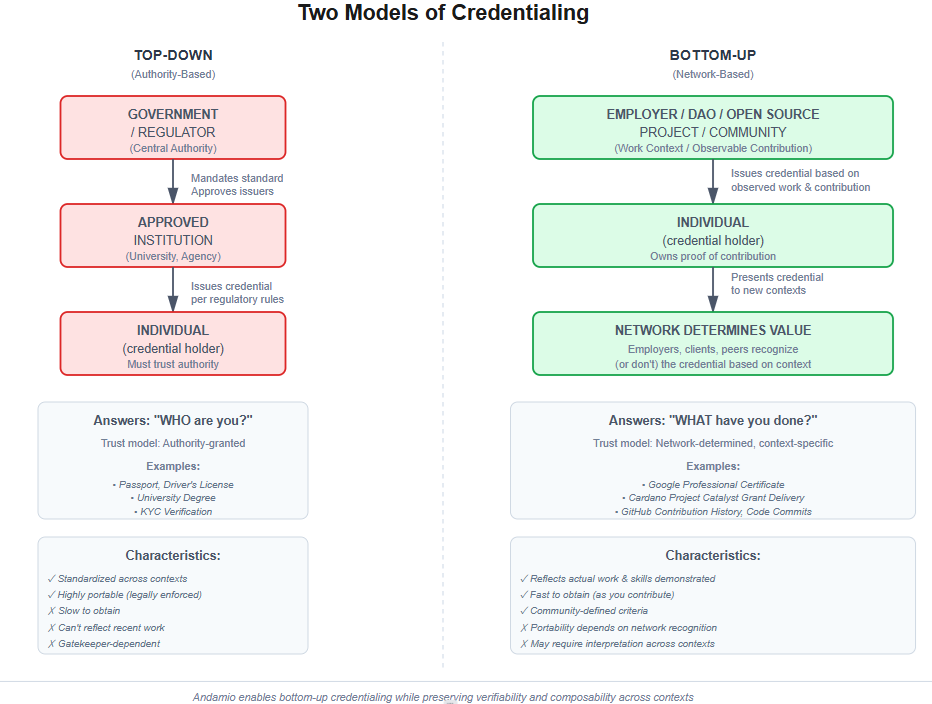
The first kind of credentials answers: “WHO are you?”
Your passport. Your national ID. Your KYC verification. These are personal identity credentials, and they absolutely require government authority. No debate there. Governments issue them, regulate them, and set the standards. If you’re building identity infrastructure, yes, you’re waiting on regulators.
The second kind answers: “WHAT have you done?”
You completed a training program. You delivered a project on time. You contributed working code to an open source repository. You participated in 200 governance votes. You passed a security audit.
These are professional credentials. And they operate on a completely different trust model.
A Google Cloud certification is valuable not because a government blessed it, but because employers recognize Google’s training rigor. A completed security audit from a respected firm like TxPipe, carries weight because protocols trust the methodology. A Catalyst milestone completion matters because the funding body verifies the delivery.
In every case, value comes from the network: employers, clients, peers, communities, recognizing the issuer’s relevance. Not from a regulatory mandate.
The issuer is the organization closest to the work. The employer. The training provider. The DAO. The open source project. The funding body.
This is bottom-up credentialing. And it’s already happening everywhere. It just doesn’t have infrastructure yet.
What Bottom-Up Actually Looks Like
Once you see the distinction, examples appear everywhere, specially in the world beyond Cardano:
Corporate training. Companies spend $380B per year training employees. Every completion certificate is locked inside an LMS (Coursera, LinkedIn Learning, internal systems). When someone changes jobs, their training history vanishes. The new employer retrains from scratch. Not because the credentials don’t exist, but because they’re not portable.
Open source. Over $100B in enterprise value runs on open source software. Contributor reputation lives in GitHub profiles, which aren’t verifiable outside GitHub and aren’t portable to job applications, grant proposals, or other projects. A maintainer who’s led 50 releases has no verifiable credential for it.
Freelancing. 150 million freelancers globally. A five-star developer on Upwork starts at zero on Fiverr. Every platform switch resets trust. The most valuable asset a freelancer has (their reputation), is locked inside the platform that collected it.
DAO governance. DAOs manage $25B+ in treasuries. Governance delegates who’ve voted on hundreds of proposals, served on committees, and managed funds have no portable proof of that experience when they participate in a different DAO.
Grant evaluation. Every funding body (Catalyst, Gitcoin, Optimism RPGF) manually verifies whether teams delivered on past grants. A team’s perfect delivery record on one platform is invisible to every other.
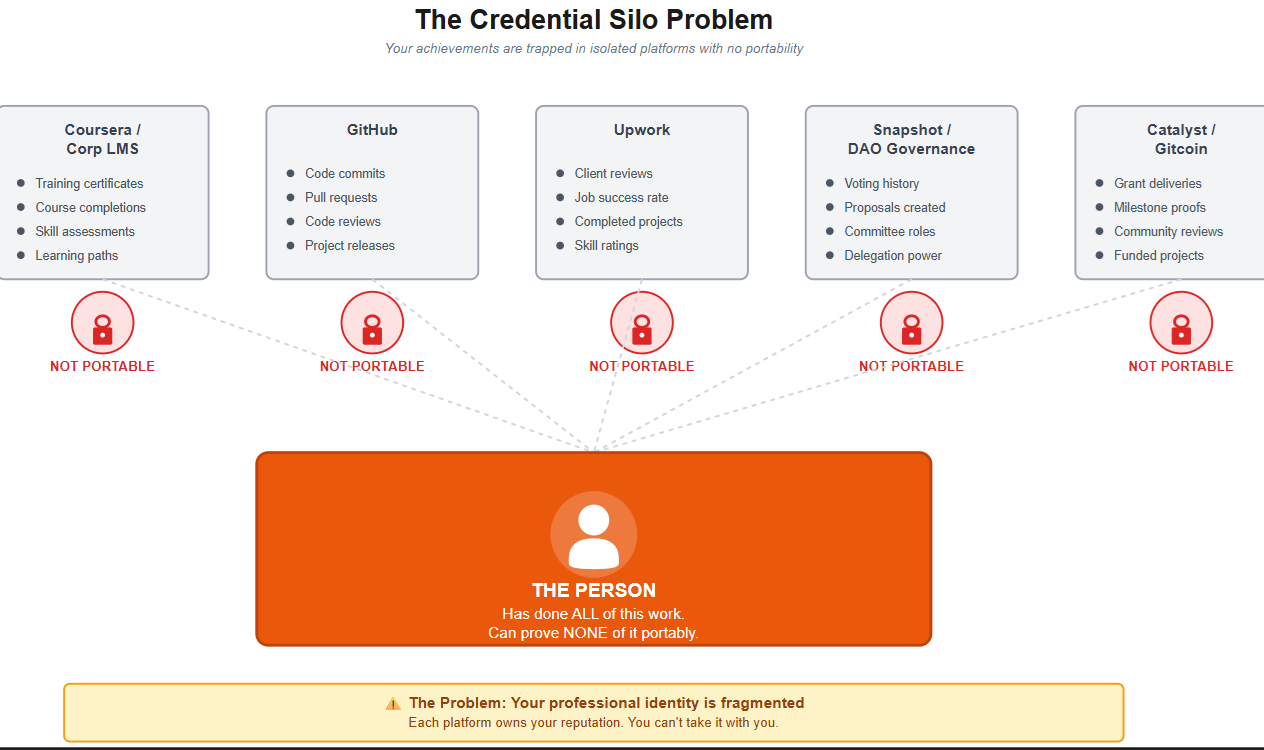
In none of these cases is anyone waiting for a government standard. The credentials are being issued by employers, by platforms, by communities. They’re just locked in silos. Not verifiable. Not portable. Not interoperable.
Why This Is a Blind Spot
There’s a reason most people in Web3 don’t see this.
The crypto industry has clear mental models for financial infrastructure: DEXs, lending protocols, stablecoins, bridges. These are well-understood product categories with established metrics.
“Credentialing protocol” doesn’t map to any of these categories. So when people encounter it, they reach for the closest frame they have. Some frame it as “government identity” and conclude it’s premature. Others frame it as a consumer application and measure it by DeFi metrics, where any credentialing protocol looks like it has thin traction.
But credentialing infrastructure isn’t a consumer app. It’s infrastructure, closer to Stripe or Twilio than to a DEX. The metric that matters isn’t end-user count. It’s: how many organizations are issuing credentials through the protocol, and across how many different use cases?
And credentialing transactions don’t look like DeFi transactions. Minting a credential is more like recording a property deed than executing a token swap. One happens once per achievement. The other happens thousands of times per second. Different activity, different rhythm, different value per transaction.
The blind spot isn’t a lack of intelligence. It’s a lack of category. When you don’t have a frame for something, you can’t see it, even when you’re doing it every day.
The Quiet Revolution
Here’s what makes this interesting.
Governments will eventually adopt verifiable credential standards for personal identity. The EU’s eIDAS 2.0 is already in motion. India Stack is operational. Dozens of national programs are underway.
But professional credentialing isn’t waiting for any of that. It’s emerging bottom-up, driven by the organizations that actually need it:
Employers who want to verify skills without relying on self-reported resumes
DAOs that need to assess contributors without traditional HR
Open source projects that want to recognize and retain maintainers
Training providers whose certificates should travel with the learner
Funding bodies that need portable proof of delivery across platforms
These aren’t hypothetical futures. These are problems being solved right now, by organizations issuing credentials through whatever tools they have, usually locked in proprietary systems with no interoperability.
The infrastructure gap is real: we have protocols for swapping tokens, lending assets, and governing treasuries. We don’t have infrastructure for the one thing every organization does daily: verifying what people have actually done.
That gap is also an opportunity. The credentials exist. The issuers exist. The need exists. What’s missing is the infrastructure layer that makes it all verifiable, portable, and interoperable.
And it doesn’t need permission.
Andamio builds credentialing infrastructure for Web3. Learn more at andamio.io